Measuring without scales, and knowing what it costs you
Every baking site tells you to buy a scale. Most people reading a recipe tonight do not have one, and the useful question is not whether cups are worse but by how much, for what. On our own sourced figures the answer ranges from about 36 percent down to nothing worth naming, and knowing which ingredient sits where is most of the skill.
The error budget, ranked
For each of our twenty ingredients we took the widest disagreement on record for one US cup: either the gap between the authorities who measured it, or the gap between filling the cup one way and another, whichever is larger. That is the size of the hole a cup can leave.
| Ingredient | Worst case, one cup | Share of the cup | Where it comes from |
|---|---|---|---|
| Rolled oats | 32 g | 36 % | which chart you read |
| All-purpose flour | 40 g | 33 % | how you fill the cup |
| Brown sugar | 68 g | 32 % | how you fill the cup |
| Powdered sugar | 13 g | 12 % | how you fill the cup |
| Vegetable oil | 20 g | 9 % | which chart you read |
| Milk | 17 g | 7 % | which chart you read |
| Yogurt | 18 g | 7 % | which chart you read |
| Water | 10 g | 4 % | which chart you read |
| Granulated sugar | 2 g | 1 % | which chart you read |
| Sour cream | 3 g | 1 % | which chart you read |
| Almond flour | 1 g | 1 % | which chart you read |
Computed from our ingredient data. Each figure traces to the master page linked.
Read the last column before the number
The size of the error matters less than its source. Where the swing comes from how you fill the cup, technique fixes it and costs nothing: fill the same way every time and your baking becomes repeatable even if it is not accurate in absolute terms. Where the swing comes from which chart you read, technique cannot help, because the disagreement is between the people who measured, not between you and them. There a scale is the only escape, and picking a number without knowing the spread is guessing with extra steps.
The ingredients a cup handles well
3 of our twenty sit at three percent or under: granulated sugar, sour cream, almond flour. Liquids dominate that list for a reason worth stating plainly. A liquid takes the shape of its container and cannot be packed, so its volume and its weight travel together and the only error left is reading the jug. Roskachestvo makes the same point when it says liquids carry no heap, which is why the fill columns on heaped versus level spoons are blank for water, milk and oil rather than repeated.
Calibrate what you own
Before trusting any chart, find out what your own vessels hold. Water is the tool: a millilitre of it weighs about a gram, so pour your spoon or cup into a marked jug, or weigh the water if you have borrowed a scale once. Our water master sets out why the near-identity holds for water and almost nothing else, and the volumes you are checking against are on tablespoon sizes by country and cup sizes around the world. A single afternoon of this converts a drawer of unknown spoons into known ones, permanently.
Fill the same way every time
For dry goods, spoon the ingredient into the cup and level it with the back of a knife rather than dragging the cup through the bag. Every baking authority says this and they are right, but the reason is worth stating precisely: it is not that spooning is correct and scooping is wrong, it is that published charts were made by spooning, so scooping puts you somewhere those charts never described. Consistency with the chart is what you are buying, not accuracy in the abstract.
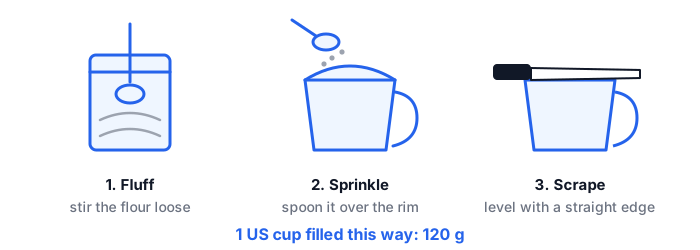
Two ingredients invert the advice, and both are on the risky end of the table above. Brown sugar is meant to be pressed in, because every chart that measures it measures it packed. Powdered sugar is meant to be sifted first when the recipe says so, which takes weight out rather than putting it in. Following the general rule on either of those makes things worse, which is why the master pages carry the method beside the number.
When to stop and borrow a scale
Three situations are worth the trip. Small quantities of powerful things, where a spoon of salt or yeast carries a large fraction of the recipe's total effect and the salt master shows the brand alone moving a spoonful by more than double. Recipes with a tight ratio, such as bread hydration, where two volume errors compound in opposite directions. And anything you intend to repeat: a cup measurement you cannot reproduce next month is a recipe you have not written down. Everything else, the top of the table aside, survives a careful cup.
Questions about measuring without a scale
- Can I bake well without a scale?
- For some things, yes. The risk is not spread evenly: our own figures put rolled oats at about 36 percent depending on which chart you read, while several ingredients sit at three percent or under. Learn which is which and a cup goes a long way.
- How do I know what my spoon or cup holds?
- Fill it with water and weigh it, or pour it into a marked jug. A millilitre of water is about a gram, so an 18 ml spoon holds about 18 g. Water is the one ingredient whose volume and weight travel together, which is what makes it a ruler.
- Which ingredient punishes a cup the most?
- Rolled oats, on our data, at roughly 36 percent. All-purpose flour and Brown sugar follow. In each case the swing comes from the sources rather than your hand, which decides whether technique or a scale is the fix.
Sources
The ranking is computed from our own ingredient dataset, and every row links to the master page that names the authorities behind it: King Arthur Baking, USDA FoodData Central, and the Australian, New Zealand and Japanese tables cited there. Roskachestvo for the statement that liquids carry no heap. Full citations on the sources page.