Why baking charts disagree, and how we pick a number
Weigh a cup of flour on two kitchen scales and you get one answer. Read two baking charts and you get two. King Arthur puts a cup of all-purpose flour at 120 grams; the USDA puts the same cup at 125, and neither made a mistake. Baking charts disagree for reasons you can check, and once you can, choosing the number to trust stops being a guess. Below is which number we publish when two authorities split, and the shortcut we refuse to take to get it.
Why baking charts disagree
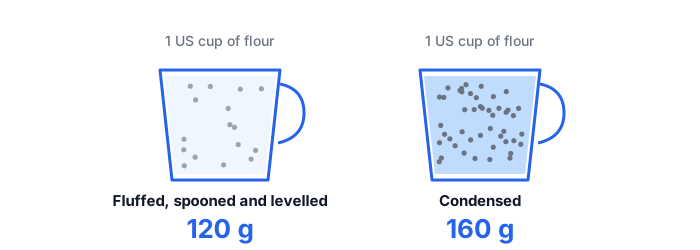
A cup measures volume, and flour has no fixed density. Spoon it in loosely and level it off and the cup holds about 120 grams. Scoop the cup straight through the bag and the flour packs down, and King Arthur reports that same cup can reach 160 grams. The chart you read is reporting the method its author used.
So the authorities differ because they measured differently, not because one is wrong. Here is the flour cup, as each authority publishes it:
| Authority | A US cup of flour |
|---|---|
| King Arthur Baking ingredient weight chart | 120 g |
| USDA FoodData Central | 125 g |
We publish 120 grams. King Arthur is the standard American recipes are written against, and King Arthur states its own recipes assume it, so a reader following a US recipe lands closest to the intended dough. The USDA figure of 125 grams is not discarded: it sits on the flour page beside ours, with the reason, so you can choose the other number if your recipe came from a different kitchen. Every ingredient page carries this same block, because for most ingredients the charts split by a few grams and for a few they split by thirty.
The same cup, filled two ways
Before you compare two charts, account for your own hand, because the method moves the number more than the authorities do. A cup of flour holds 120 grams fluffed and 160 grams packed, a gap of a third, while King Arthur and the USDA sit five grams apart. Where an authority measured a cup both ways, we publish both and label them, so you can match the state your recipe assumes.
| Ingredient | Lighter fill | Firmer fill |
|---|---|---|
| All-purpose flour | 120 g, fluffed, spooned and levelled | 160 g, condensed |
| Brown sugar | 145 g, unpacked | 213 g, packed |
| Powdered sugar | 100 g, sifted | 113 g, unsifted |
Brown sugar shows the widest gap: pressed into the cup it holds 213 grams, spooned in loose it holds 145, so a recipe that means packed and a cook who measures loose are a third of the sugar apart before any chart is opened. This is why a bare number without its state is close to useless, and why our ingredient pages name the fill on every row.
Why we never scale a number
Most converters store one weight per ingredient and multiply. They take a cup of flour, divide by 48, and call the result a teaspoon; or they take a US cup and scale it to a 200 ml Japanese cup by the ratio of the volumes. That arithmetic looks exact and reads as authority, and it is wrong for any powder.
The Japanese standard measuring tables prove it against themselves. They record flour at 3 grams per teaspoon. A cup is 40 of their teaspoons by volume, so multiplication predicts 120 grams. The measured cup in the same table is 110. Flour settles differently in a teaspoon than in a cup, so the two readings do not share a ratio. We store every measured value on its own, from the table that measured it, and we leave a field blank rather than fill it by calculation. A blank on our page means no authority measured that combination, which is a sentence the calculators cannot write.
The eight-ounce rule is a fact about water
A US cup holds 236.6 millilitres, and a millilitre of water weighs almost exactly a gram, so a cup of water weighs close to 8 ounces. That coincidence became a rule of thumb, and the rule then got applied to everything poured into a cup. It holds for water and breaks for the rest.
Milk carries dissolved sugar and protein, so it runs denser: the USDA weighs a cup of whole milk at 244 grams, not the 227 that the eight-ounce rule predicts. The Japanese tables show the same gap from the other side, weighing milk at 210 grams against water at 200 for their smaller cup. Honey is heavier again, and oil is lighter. We give each liquid its own measured weight instead of treating a cup of liquid as a cup of water.
How we version the numbers
A source is only as current as its last revision, so we record which edition each number came from. The USDA weights we use come from its SR Legacy set, which the agency froze in 2018 and no longer updates; its newer database drops the cup portions entirely, so the frozen set is the one that still answers a baker. When we cite a European egg standard, we cite the 2023 regulation that replaced the 2008 one, not the withdrawn text that most charts still name. If a figure changes at its source, the change belongs to us to catch, not to you.
That promise needs a date beside it or it is only a sentence, so every entry on the sources page carries the day we last opened the link and read the figure off it. The whole registry was last checked on . The first run of that check found three dead links and a flour bag reformulated from 10 grams of protein to 8.4 under a URL that still answered, which is roughly the rate of decay a list this size should expect.
How to measure so your cup matches ours
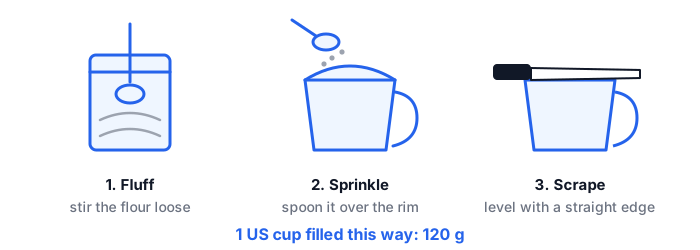
Our flour number assumes the method King Arthur recommends, which it calls fluff, sprinkle and scrape. Loosen the flour in its container with a spoon, since flour compacts as it sits. Spoon it into the cup until it mounds over the rim, without tapping or pressing. Level the top with the back of a knife. Measured this way, a cup holds the 120 grams we publish; scooped straight from the bag, it holds more, and the heavier your hand the further your loaf drifts from the recipe. A scale removes the question, which is why we show grams first.
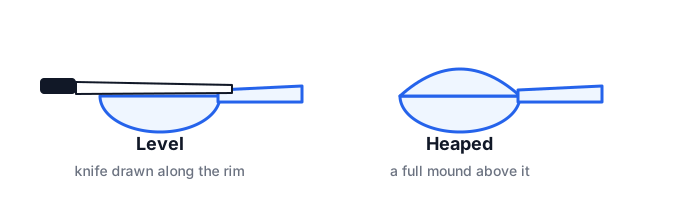
Level a spoon the same way. A recipe asking for a tablespoon means a level one, so draw the knife along the rim as you would across a cup. A heap is a separate measurement, and the figures charts publish for it sit on heaped and level spoons.
The same discipline decides what we print for measures that are not weights. Oven scales are the clearest case: the French thermostat is a rule we can verify arithmetically, while the German Stufe is a convention its own publisher calls appliance-dependent, and oven temperatures keeps that distinction visible instead of printing all three national scales as equally solid. The yeast converter does the same with dosing, where two manufacturers disagree and we publish the conservative reading, and egg sizes marks two whole columns as derived because the USDA sets its weight classes in ounces and never in grams.
Sources
King Arthur Baking ingredient weight chart and its guide to measuring flour. USDA FoodData Central, SR Legacy portion weights. The Kagawa Nutrition University standard measuring tables, as reproduced by Benricho. Dr. Oetker and Roskachestvo for spoon weights. Full citations for every figure, with links, live on our sources page.
Two pages carry this thinking further: the list of every source behind the numbers, and the way we answer questions you send through the contact page. Why the site publishes without bylines, and how it is paid for, sits on the about page, and our approach to your data is on the privacy page.