Heaped and level spoons, and why level is not the safe half
A tablespoon in a recipe means a level one unless the recipe says otherwise. That much is settled. What is not settled is the level spoon itself: published charts put a level tablespoon of flour at anywhere from 7 to 20 grams on the same 15 millilitre spoon. The heap is the famous problem. The flat spoon is the quiet one.
What level and heaped mean, when anyone bothers to say
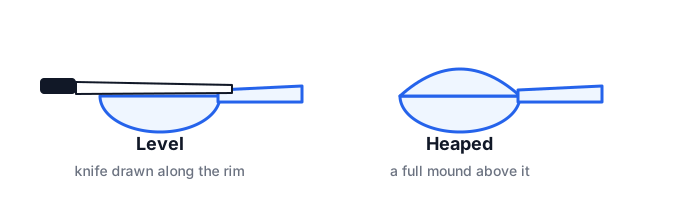
Most charts print a number and leave the method to your imagination. Roskachestvo, the Russian state quality agency, is the exception we lean on here: it defines level as the spoon filled and the excess taken off with a knife drawn along the rim, and heaped as a spoon carrying a full mound. It then publishes both, at two different spoon volumes, for fourteen ingredients. No English-language chart we found does this.
The grid: level and heaped at two spoon sizes
Grams per spoon. The 18 millilitre spoon is the Slavic standard and the 15 millilitre one is the German, British and American size; which one is in your drawer is the subject of tablespoon sizes by country.
| Ingredient | Level, 18 ml | Level, 15 ml | Heaped, 18 ml | Heaped, 15 ml |
|---|---|---|---|---|
| Wheat flour | 20 | 17 | 27 | 23 |
| Granulated sugar | 14 | 12 | 25 | 20 |
| Rice, round grain | 20 | 17 | 27 | 23 |
| Cocoa powder | 5 | 4 | 7 | 6 |
| Fine "Extra" salt | 22 | 18 | 30 | 25 |
| Himalayan salt | 12 | 10 | 14 | 12 |
| Powdered sugar | 11 | 9 | 15 | 12 |
| Ground nuts, almond flour | 7 | 6 | 12 | 10 |
| Starch | 7 | 6 | 11 | 9 |
| Honey, liquid | 30 | 25 | no heap | no heap |
| Milk | 18 | 15 | no heap | no heap |
| Water | 18 | 15 | no heap | no heap |
| Sunflower oil | 18 | 15 | no heap | no heap |
| Sour cream | 20 | 17 | not published | not published |
All figures Roskachestvo, grams per spoon. Blank heaps are explained below.
A level tablespoon of flour is an argument, not a number
Take the one measurement everybody treats as reliable and collect what the charts publish for it, holding the spoon at 15 millilitres throughout:
| Source | Level tablespoon of flour |
|---|---|
| Dr. Oetker | 7 g |
| Klopotenko | 8-9 g |
| Koch-Wiki, Swissmilk and four others | 10 g |
| Aleja Smaku | 12-13 g |
| food.ru | 15 g |
| Roskachestvo | 17 g |
| pro100media | 20 g |
Nearly three times as much flour at the bottom of that list as at the top, for the same instruction on the same spoon. Some of the spread is real: flour compacts in the bag, and a chart that scooped will read heavier than one that spooned, the same effect our flour master tracks between the two US authorities. Some of it is nobody declaring their spoon. And some of it is charts copying each other, which is how six separate sites arrive at exactly 10 g. Averaging this list would produce a number no one measured, which is why our ingredient pages name the authority behind each figure instead.
Liquids do not heap
Water, milk, oil and liquid honey carry no heaped figure above, and the blank is deliberate. Roskachestvo states the reason: with liquids there is no concept of a heap, because the weight follows the volume. Pour a spoon of water past its rim and it runs off, so an 18 millilitre spoon holds 18 grams of water and that is the end of it. This is also the best calibration trick in the kitchen: fill your own tablespoon with water and weigh it, and you learn which spoon you own. Our water master uses the same test.
Thick liquids sit in between. Sour cream keeps a mound and Roskachestvo still declines to publish one, which is a more honest position than the sites that print a heaped figure for yogurt without saying who measured it.
Salt is two ingredients wearing one word
Look at the salt rows: fine "Extra" salt reads 22 g on the 18 millilitre spoon and Himalayan salt 12, nearly half, at the same volume. Crystal size decides it, not chemistry. That is the same finding our salt master reaches from two other directions entirely: the Japanese tables split fine and coarse salt by a third, and the American kosher brands sit more than two to one apart on one spoon. Three traditions, one conclusion, and it means a salt figure without a grain size attached is not usable.
How charts go wrong, and how to spot it
Three failures turned up often enough while assembling this page to be worth naming. The first is an undeclared spoon: a chart printing 17 g for a level tablespoon of flour and one printing 7 g may not disagree about method at all, since one is measuring 18 millilitres and the other 15. The second is a table that is already heaped without saying so on the row you are reading: gutekueche.de states in its own preamble that its dry-goods figures assume a lightly heaped spoon, and its level column covers only liquids and fats, so anyone comparing it against a level chart is comparing two different measurements. The third is invented precision. grammloeffel.de publishes teaspoon values for every ingredient, and its own page script generates them by dividing the tablespoon by three; the underlying data file holds tablespoons only. A derived number presented in the same column as a measured one is indistinguishable to a reader, which is why our methodology page insists on naming who measured what.
The practical upshot is short. If a recipe says a spoon and the amount matters, weigh it. If you have no scale, level the spoon with a knife and accept that you are within about a third of what the author meant. The American tablespoon at 14.7867648 millilitres and the metric one at 15 differ by less than the way you fill them, which tells you where the real error lives.
Questions about heaped and level spoons
- Does a recipe mean level or heaped?
- Level, unless it says otherwise. German recipes make this explicit: a bare EL is level and a heap is written as gehäuft. The trouble is that level is less settled than it sounds.
- How much bigger is a heaped spoon?
- Between about half again and two and a half times, depending on whose chart you read and what is on the spoon. On the 18 millilitre grid above, flour goes from 20 g level to 27 g heaped, while granulated sugar nearly doubles.
- Can you heap a liquid?
- No. Roskachestvo puts it plainly: with liquids there is no concept of a heap, and the weight follows the volume. That is why the liquid rows above have no heaped figure rather than a repeated one.
Two neighbouring problems live on their own pages: what the oven number means once the dough is mixed is on oven temperatures, and the packets that raise it are on the yeast converter. If you have no scale at all, measuring without scales ranks which ingredients forgive a cup, and Eastern European measurements shows a culture where a bare spoon is heaped by default.
Sources
Roskachestvo (rskrf.ru) for the level and heaped grid at both spoon volumes, the definitions of level and heaped, and the statement that liquids carry no heap. Dr. Oetker, Klopotenko, Koch-Wiki, Swissmilk, Aleja Smaku, food.ru and pro100media for the published level tablespoons of flour. Gutekueche.de and grammloeffel.de as the two charts whose method notes change how their figures may be used. Full citations on the sources page.